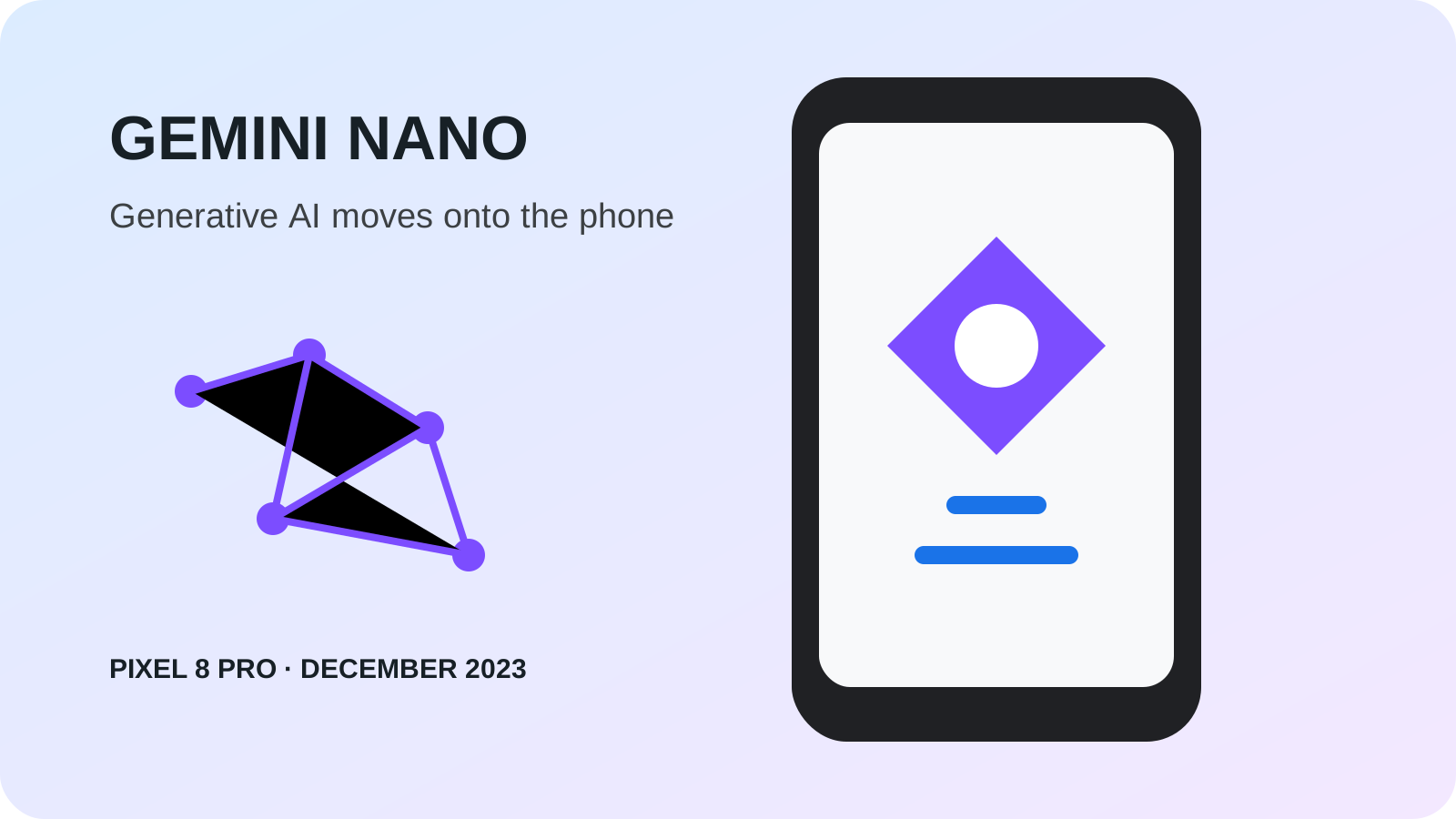
On December 6, 2023, Google began running Gemini Nano on the Pixel 8 Pro. The December Pixel Feature Drop used the small model for two initial experiences: summarizing recordings without a network connection and generating contextual Smart Replies in Gboard for supported messaging apps. Google described the Pixel 8 Pro as the first smartphone engineered for Gemini Nano, a manufacturer claim tied to that launch rather than a neutral ranking of every phone.
The milestone did not mean that a full cloud chatbot had been copied into a handset. Gemini was a family of differently sized models, and Nano was designed for constrained devices. Its arrival is historically useful because it made the location of AI processing—on the phone or in a data center—part of an ordinary smartphone feature discussion.
What was Gemini Nano at its 2023 launch?
Google introduced Gemini in Ultra, Pro and Nano sizes. Nano was the most efficient version, intended for tasks that could run on mobile silicon. A smaller on-device model necessarily had different capabilities and resource limits from a much larger remote model. “Gemini” therefore did not identify one identical intelligence operating everywhere.
The Pixel 8 Pro used its Tensor G3 system-on-chip for the initial deployment. Google had introduced Tensor G3 in October as a design prepared for more complex on-device machine learning. That hardware context matters: Android 14 alone did not make Gemini Nano appear on every phone running the operating system.
The December Feature Drop was the point at which the model powered visible consumer features. The model, system service, app and compatible hardware all had to work together. This layered arrangement became a recurring pattern for later mobile AI.
Which features actually ran on the phone?
Recorder’s Summarize feature could condense a compatible recording on the Pixel 8 Pro without uploading it for cloud processing. That was useful in places without connectivity and created a clearer data boundary for recordings that a user preferred not to send away. Language, length and availability limits still applied; “offline” did not mean the model could summarize every possible audio file in every language.
Gboard’s Smart Reply used Gemini Nano to suggest responses with more conversational awareness. It began as a developer preview with U.S. English and selected messaging services. The feature concerned suggested text in a messaging workflow, not autonomous sending. A person still chose whether to use or edit a response.
| Initial Pixel 8 Pro use | Input | Output | On-device advantage |
|---|---|---|---|
| Recorder Summarize | Transcript from a supported recording | Short written summary | Could operate without a network request |
| Gboard Smart Reply | Recent supported chat context | Suggested response | Context could be processed locally |
| AICore model service | App request and model resources | Managed inference access | Centralized model, runtime and safety handling |
The narrow initial list is important. Many later features were discussed under the broad label of AI, but the December 2023 evidence supports two specific consumer uses and an early developer foundation.
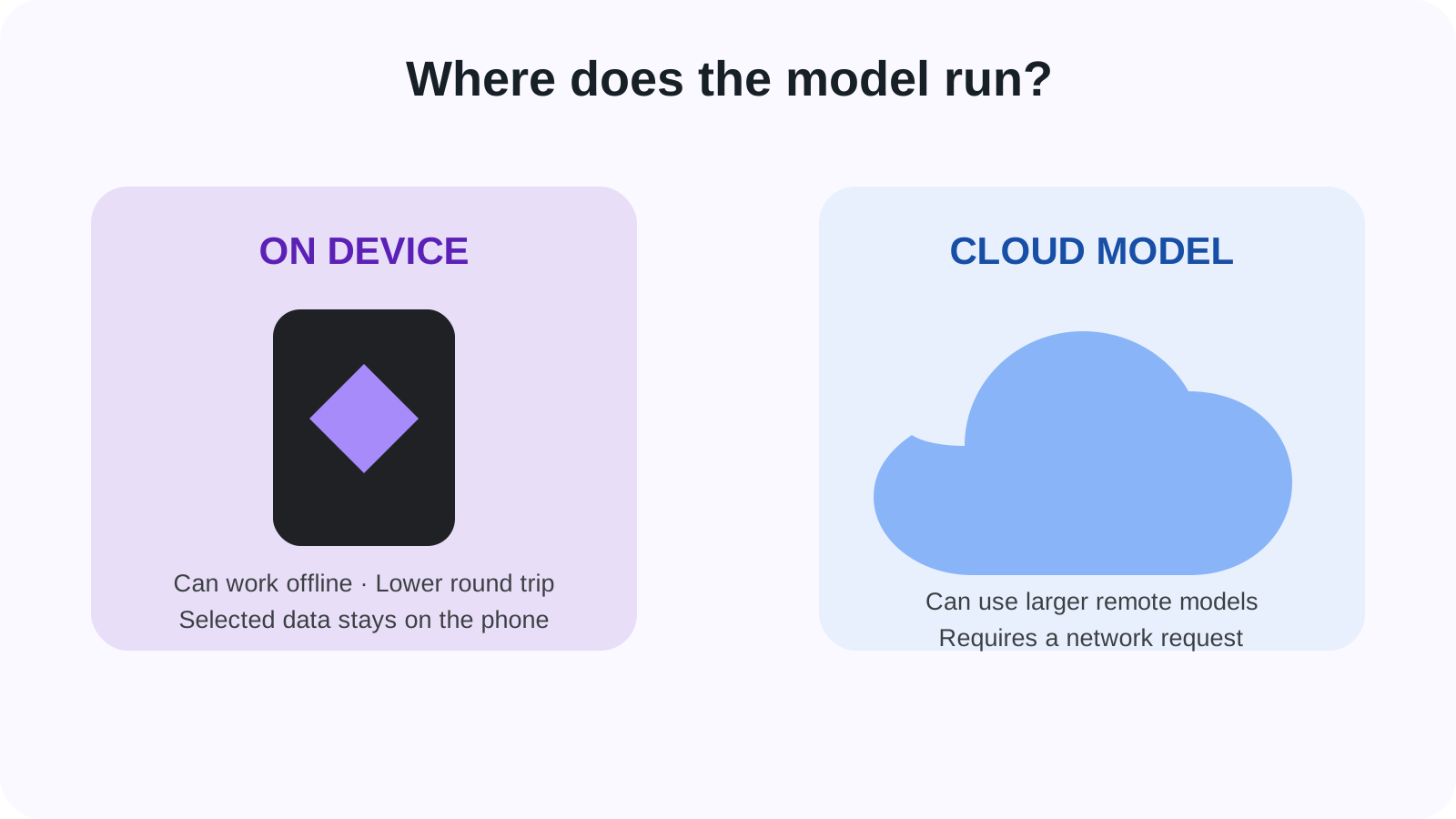
Why was on-device processing significant?
Sending data to a remote model can provide access to more computing power, but it requires a network trip and moves information across a wider system. Local processing can reduce that round trip, work offline and keep selected input on the device. Those are advantages, not guarantees that every local result is instant, accurate or private under every surrounding app behavior.
The phone still had to store model resources and spend processor time, memory and energy on inference. A model compact enough for a handset could be less capable than a cloud service, while a demanding task could affect temperature or battery use. Product teams therefore had to decide which jobs were suitable for local execution and which required remote help.
The most durable idea was not “local always wins.” It was that phones could use a hybrid architecture. Sensitive or latency-conscious tasks might stay on the device, while larger or frequently updated models remained in the cloud. Later Android AI features continued to make that boundary an explicit design choice.
What role did Android AICore play?
Google’s developer announcement introduced AICore as an Android 14 system service. Rather than requiring every app to package and maintain a separate copy of the foundation model, AICore was designed to manage the model, runtime and safety features and expose supported access to applications.
Google described AICore as isolated from direct network access and built around open-source APIs, following ideas used in Android’s Private Compute Core. It also discussed Low Rank Adaptation, or LoRA, as a way for developers to attach smaller task-specific adapters to a shared model. In December 2023 this was an early-access developer direction, not proof that any app could freely modify Gemini Nano on any handset.
A system service matters because models are large and platform security is easier to reason about when access passes through a managed layer. It also gives the platform a route to update components and apply policies. The trade-off is that availability becomes dependent on the platform provider, device support and approved APIs rather than merely on an app download.
Did Gemini Nano make the Pixel 8 Pro an “AI phone”?
Google marketed the Pixel 8 Pro as a phone with AI built in, but machine learning had shaped smartphone photography, speech recognition and spam filtering long before Gemini Nano. The new element was a general-purpose generative model small enough to support multiple text-oriented tasks on the device through a shared Android service.
It is therefore more accurate to describe a change in the kind of on-device AI, not the birth of phone AI itself. Earlier models were often optimized for one job, such as detecting faces or reducing image noise. A foundation model could be adapted across several tasks, although each still needed product design, testing and safety limits.
The wording also should not erase cloud processing. Some Pixel camera and assistant features continued to use Google’s servers. A feature appearing on a phone does not prove that all computation happens inside it; official product documentation must be checked feature by feature.
What were the limits and uncertainties in 2023?
Initial Gemini Nano access was narrow. Google named the Pixel 8 Pro, selected languages and selected apps. Model outputs could be incomplete or wrong, and a generated summary was not a certified record of a meeting. Users still needed to review suggested text before relying on it.
There was also no basis in December 2023 for claiming that every future Android phone would run the same Nano model. Hardware accelerators differ, memory budgets vary and manufacturers choose their own software roadmaps. Google said more devices and silicon partners would be announced, which was a forward-looking plan rather than completed availability.
This distinction mirrors the Pixel 8 series’ seven-year update promise: a long support horizon created an opportunity for features to evolve, but did not promise that all future capabilities would run identically on first-generation hardware.
Why does the Gemini Nano milestone still matter today?
By 2026, on-device models, scam detection, transcription and hybrid AI services had become ordinary parts of flagship-phone discussions. The December 2023 Pixel release remains important because it gave the public a concrete example of a foundation model doing useful work locally, with named apps and observable limits.
It also established questions that remain more valuable than the “AI” label: Where does the model run? What information leaves the phone? Does the feature work offline? Which languages and devices are supported? Can the user review the result before an action occurs? Those questions help people understand a tool without treating marketing language as a technical explanation.
Gemini Nano sits in the wider Android history timeline after Android 14 created the AICore setting and before later releases put AI deeper into search, assistants and security. Its significance is the beginning of that platform pattern, not the claim that the first implementation was already complete.