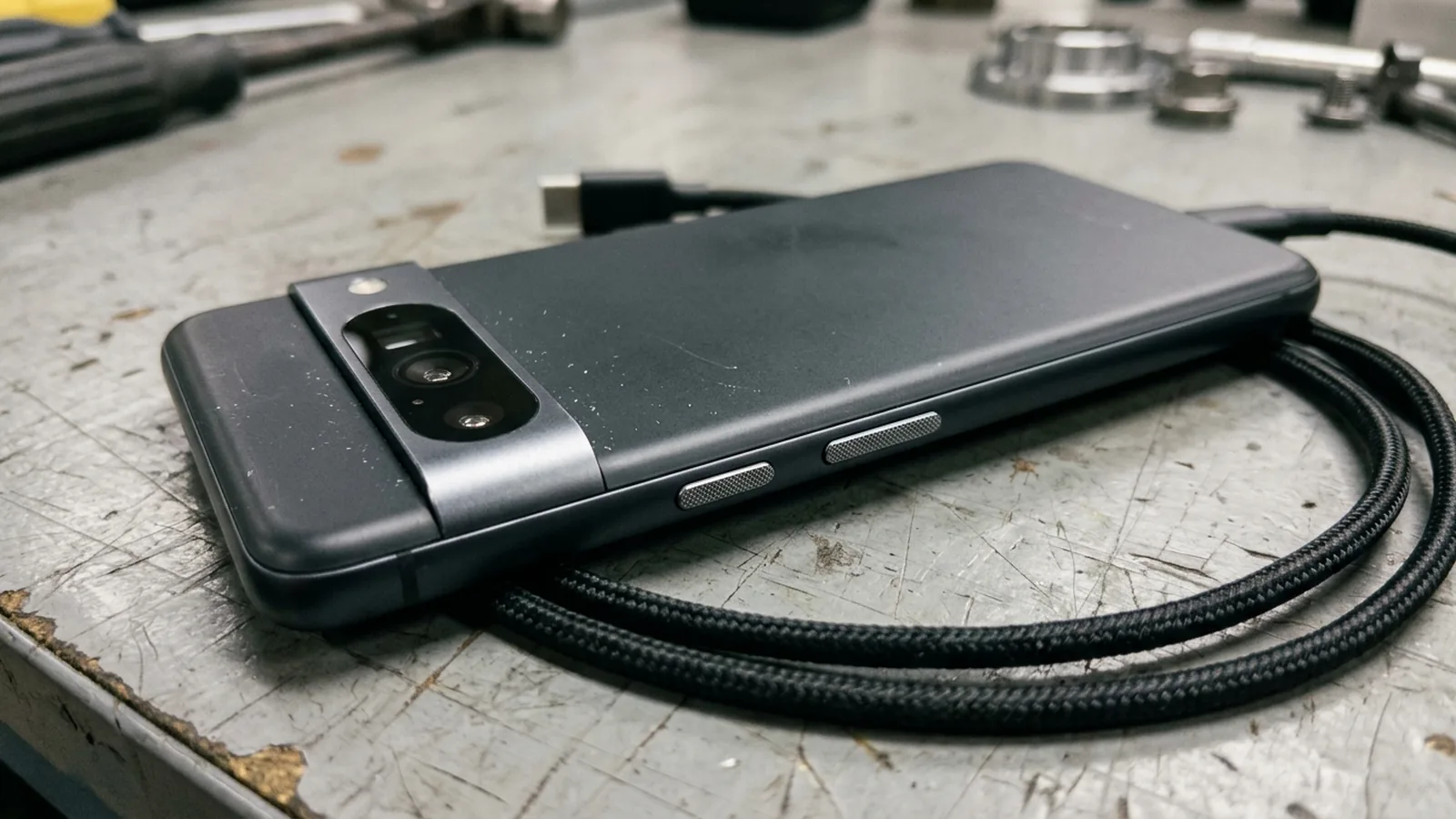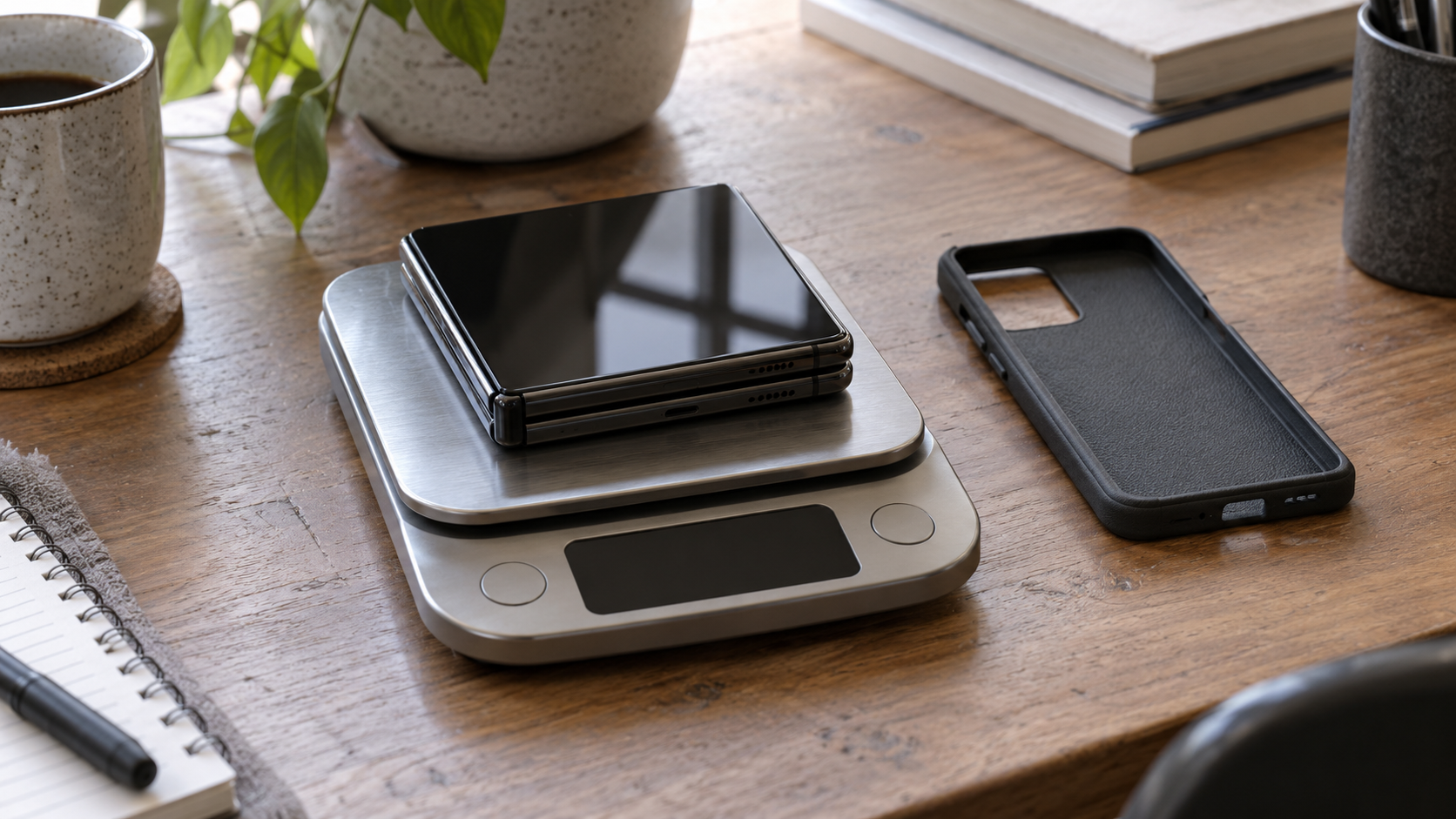
Selecting a foldable by megapixels alone risks approving a camera that does not meet the job’s output needs. Compare the listed resolution, optical zoom and carrying weight against the workflow, then pilot the shortlisted devices. This is a comparison of manufacturers’ public specifications, not our device testing.
Key takeaways
- Pixel 11 Pro Fold and Fold8 Ultra both open to 8-inch displays, but Samsung’s Ultra is 24 g lighter, thinner and has a larger nominal battery.
- Galaxy Z Fold8 is lighter still at 201 g, but its 5.5-inch cover screen and 7.6-inch inner display create a different, more landscape-oriented product.
- Pixel carries an IP68 rating; both Samsung models are IP48. Read the particle digit carefully and do not market any foldable as permanently waterproof or damage-proof.
- Fold8 Ultra lists 200 MP main and 50 MP ultrawide cameras; Pixel lists 5x optical telephoto versus Ultra’s 3x; Fold8 omits a dedicated telephoto. These figures do not rank image quality.
- Procurement should compare regional warranty, repair time, accessories, app layouts and lifecycle cost—not only launch specifications.
Pixel 11 Pro Fold vs Fold8 Ultra vs Fold8 at a glance
Google announced Pixel 11 Pro Fold on August 12, 2026, three weeks after Samsung unveiled its eighth-generation Fold family. All three are book-style foldables, but they make different compromises.
| Specification | Pixel 11 Pro Fold | Galaxy Z Fold8 Ultra | Galaxy Z Fold8 |
|---|---|---|---|
| Inner display | 8.0-inch, 2,076 × 2,152, 1–120Hz | 8.0-inch, 2,504 × 2,256 | 7.6-inch, 1,848 × 2,448 |
| Cover display | 6.5-inch, 1–120Hz | 6.5-inch | 5.5-inch |
| Weight | 239 g | 215 g | 201 g |
| Folded thickness | 10.1 mm | 8.9 mm | 9.7 mm |
| Unfolded thickness | 5.0 mm | 4.1 mm | 4.5 mm |
| Typical battery | 4,806 mAh | 5,000 mAh | 4,800 mAh |
| Listed wired charging | 50% in about 30 min with compatible 30W+ PPS | Up to 45W | Up to 45W |
| Wireless charging | Qi2.2/Pixelsnap up to 25W | Verify regional specification | Verify regional specification |
| Main rear camera | 48 MP | 200 MP | 50 MP |
| Ultrawide | 10.5 MP | 50 MP | 50 MP |
| Telephoto | 10.8 MP, 5x optical | 10 MP, 3x optical | None listed |
| Maximum storage | 1 TB | 1 TB | 1 TB |
| RAM | 16 GB | 12 GB with 256 GB or 512 GB; 16 GB with 1 TB | 12 GB with 256 GB or 512 GB; 16 GB with 1 TB |
| Ingress rating | IP68 | IP48 | IP48 |
| Software at launch | Android 17 | Android 17 / One UI 9 | Android 17 / One UI 9 |
Specifications are manufacturer figures. Samsung lists Fold8 Ultra and Fold8 memory by storage tier and notes that memory and storage options vary by market. Charging equipment is sold separately, and regional configurations can change. Confirm exact model number, radio support, SIM configuration, storage, warranty and included items before ordering.
Which foldable is easiest to carry?
Weight creates the clearest hierarchy. Fold8 is 201 g, Fold8 Ultra 215 g and Pixel 11 Pro Fold 239 g. The Pixel is 38 g heavier than Fold8 and 24 g heavier than Ultra before adding a case.
Samsung also leads published thickness. Fold8 Ultra measures 8.9 mm folded and 4.1 mm unfolded, while Pixel measures 10.1 mm and 5.0 mm. A millimeter sounds small in a table but affects pocket feel, mounts and how the phone balances in one hand.
Geometry matters as much as mass. Pixel and Ultra use 6.5-inch cover displays that behave more like conventional phones. Fold8 is shorter and wider with a 5.5-inch cover screen, then opens into a 4:3-oriented landscape workspace. That can be excellent for reading, games and video, but users who type frequently without unfolding should test it first.
For mixed fleets, issue physical dummy units or pilot devices with the approved case. Paper dimensions do not reveal thumb reach, keyboard comfort, trouser-pocket fit or how often a user decides not to unfold the phone.
Which display and multitasking experience is better?
Pixel 11 Pro Fold and Fold8 Ultra both have 8-inch inner displays. Pixel lists 1–120Hz operation and up to 3,600 nits peak for both inner and cover screens. Samsung’s Ultra uses a higher pixel count and One UI’s established multi-window tools.
Pixel’s big-screen workflow includes Split Screen, Drag and Drop, Instant View and an optimized Bubbles experience that can keep an app accessible at the bottom-right when unfolded. Samsung offers two- and three-way split views in One UI 9, subject to app support, plus its wider Galaxy ecosystem and DeX-related workflows where supported.
Fold8’s 7.6-inch display is smaller by diagonal but deliberately landscape-first. It may be the better shape for video, reading or wide dashboards, while Pixel and Ultra are more conventional book-style productivity devices.
There is no specification that proves an app will use any of them well. An Android application can stretch a phone layout across the full screen, restart during fold/unfold or place controls at a hinge. Use the test matrix in our Fold8 app optimization guide on all target devices. Developers should also review the historical context in our Pixel Fold large-screen guide.
How do the camera specifications differ?
Samsung’s public specifications list Fold8 Ultra with a 200 MP main, 50 MP ultrawide and 10 MP 3x optical telephoto. That is a higher listed main and ultrawide pixel count than Pixel’s, not evidence of better inspection, property or event photos. Choose test scenes from the actual job before comparing outputs.
Pixel 11 Pro Fold pairs a 48 MP main with 10.5 MP ultrawide and 10.8 MP 5x optical telephoto, supporting computational Super Zoom up to 30x. It also includes Magic Capture, Camera Looks, dual-screen preview and Google’s photo-processing workflow. Its telephoto reaches farther optically, while Ultra uses larger published main and ultrawide resolutions.
Fold8 uses 50 MP wide and 50 MP ultrawide cameras but no dedicated telephoto in Samsung’s global specification. It may be sufficient for documentation and social media, but buyers should not assume digital cropping replaces an optical telephoto.
Test final outputs instead of declaring a winner from megapixels. Compare motion, low light, text capture, barcode performance, stabilization, microphones, storage usage and upload time. If an AI or cloud processing step is required, include connectivity and data policy in the acceptance test.
Does IP68 make Pixel safer for industrial use?
Google lists Pixel 11 Pro Fold as IP68. Samsung lists Fold8 Ultra and Fold8 as IP48. In an IP code, the first digit concerns solid-particle ingress and the second concerns water. Pixel’s “6” is a stronger published dust classification than Samsung’s “4”; both list “8” for water under manufacturer test conditions.
That difference is meaningful, but it does not make Pixel damage-proof. Google says resistance is not permanent and may diminish through wear, repair, disassembly or damage. Samsung similarly warns that IP48 does not justify beach or pool use and that resistance can diminish.
Foldables retain mechanical and flexible-display risks that an ingress code does not measure. Pixel uses a new gearless hinge, glass-fiber composite back and ceramic cover glass; Google claims three times the durability of Pixel 10 Pro Fold under internal testing. Samsung uses Flex Titanium display support and its own hinge engineering. These claims use different tests and cannot be converted into a cross-brand durability score.
For dusty, wet or high-impact work, include temperature exposure, the environment, case, screen protector, cleaning procedure, repair path, spares and warranty in the review. A conventional rugged phone may still be the correct answer.
Which battery and charging setup is better?
Fold8 Ultra has the largest nominal battery at 5,000 mAh. Pixel’s 4,806 mAh and Fold8’s 4,800 mAh are effectively similar on paper. Actual runtime will depend on display use, signal, multitasking, camera, AI workloads and power management.
Samsung lists up to 45W wired charging for both Folds. Google says Pixel can reach 50 percent in about 30 minutes with compatible 30W PPS equipment. Pixel also lists built-in Qi2.2/Pixelsnap wireless charging up to 25W, a useful advantage for standardized magnetic desk and vehicle mounts.
Charging wattage is not a complete speed comparison, and manufacturer percentages use different batteries and methods. Test the complete approved charging kit from a common starting percentage under the case and workload used in the field. Include thermal behavior and cable strain.
How do Pixel software and One UI differ for business use?
Pixel gives buyers Google’s reference Android experience, seven years of OS, security and Pixel Drop updates, Tensor G6 and Titan M3. It is a logical fit for organizations already validating on Pixel or prioritizing Google’s camera, security and Gemini integrations.
Samsung ships Android 17 with One UI 9 and advertises up to seven generations of OS upgrades and security updates. Its differentiation lies in Galaxy multitasking, Samsung services, Knox ecosystem integration and the breadth of existing enterprise accessories and service channels.
Neither brand’s AI catalog should be accepted as globally uniform. Gemini Intelligence and Galaxy AI functions vary by market, language, age, account, supported app and service terms. Determine whether data runs locally or in the cloud using our Android AI execution guide, then approve individual features rather than a marketing label.
Which model fits each business role?
| Role | Candidates to compare | Listed difference / criterion | Validate |
|---|---|---|---|
| Camera-intensive field work | Pixel and Ultra | 5x versus 3x optical telephoto; 48 MP versus 200 MP main | Target-app output quality, repair and IP needs |
| Google-first software fleet | Include Pixel in the pilot | Pixel platform, 5x telephoto, IP68 | Weight, service region and app layouts |
| Travel and mobile reading | Compare Fold8 with Pixel / Ultra | 201 g versus 239 g / 215 g; different display shape | Cover-screen typing and app scaling |
| Executive multitasking | Pixel or Ultra pilot | 8-inch inner displays | Preferred UI, security stack and accessories |
| Dust-heavy industrial work | Foldable and conventional-phone pilot | IP68 versus IP48 does not settle suitability | Flexible-screen, hinge and environmental exposure |
| Large standardized rollout | None without pilot | Foldables add repair and behavior variables | TCO, spares, support and training |
The decision should follow the workflow. A device that is lighter but requires constant unfolding can be less convenient. A 200 MP camera adds no value when the business app compresses every upload. A stronger IP code does not compensate for slow regional repair.
What should a foldable procurement pilot include?
Use the same applications, identity, network, case and charging equipment planned for production.
- Confirm the exact regional SKU, bands, SIM format and warranty.
- Enroll through the production MDM/EMM path.
- Run core tasks on cover and inner displays.
- Fold, unfold, rotate and resize during in-progress work.
- Test camera capture, scan overlays and upload.
- Measure a full shift and approved charging session.
- Exercise hinge, case, screen protector and cleaning process.
- Record repair quote, turnaround, loaner and spare policy.
- Compare user task completion and error rate against a conventional phone.
Approve only when the pilot demonstrates better task completion, preserves the required device state and has acceptable support and total cost. Price the device, protection, accessories, staging, spares, repairs and residual value together. Our detailed Galaxy Z Fold8 lineup guide provides additional Samsung selection detail, while the Pixel 11 lineup guide shows when a non-folding Pixel may deliver the same platform benefits at lower complexity.
Decide after the pilot
The public figures describe different trade-offs: Pixel lists 5x optical telephoto and IP68; Ultra lists higher main and ultrawide camera pixel counts and weighs 24 g less than Pixel; Fold8 lists 201 g but no dedicated telephoto. Those differences help define pilot tasks, not an overall camera or fleet ranking.
For an individual, choose the software and shape you prefer. For a business, pilot all shortlisted devices, calculate lifecycle cost and treat regional repair capability as a first-class specification. The best foldable is the one whose large screen improves a verified workflow enough to justify its added mechanical and support complexity.