On November 14, 2018, Google began releasing Night Sight for the first three generations of Pixel phones. Pixel 3 was the feature’s showcase: it could make a bright, detailed photograph in dim conditions without firing a flash or asking the photographer to carry a tripod. The result looked simple in the camera app, but it depended on a carefully managed sequence of exposures and computation.
Night Sight was an important Android-phone milestone because it made the camera pipeline itself part of the product. A phone no longer had to rely on one long exposure or one supposedly perfect frame. It could observe movement, collect several imperfect frames and combine them into a more useful picture. That idea now feels ordinary, but Pixel 3 made it unusually visible to mainstream users.
Why was taking a useful phone photo at night so difficult?
A small phone camera receives less light than a large camera system in the same scene. Keeping the shutter open longer gathers more light, but a photographer’s hands move and people in the scene rarely remain perfectly still. A long exposure can therefore turn noise into blur rather than into a clear photograph. Using a shorter exposure reduces motion blur but leaves the image dark and noisy. Flash can illuminate a nearby subject, yet it changes the atmosphere and does little for a distant street or landscape.
Google’s technical account of Night Sight explained that optical image stabilization helped the Pixel 2 and Pixel 3 with moderate hand movement, but Google explained that it could not solve every long exposure or moving-subject problem. Autofocus also becomes unreliable when a scene is extremely dark. Night photography was consequently not one problem with one setting; it required the camera to balance brightness, noise, hand shake, scene movement, focus and color.
Night Sight approached those constraints as information to manage. The phone could choose shorter frames when movement was present and longer ones when the device and scene were stable. That flexibility was more important than simply claiming a longer shutter time.
How did Night Sight build one image from many frames?
When the shutter was pressed, Night Sight captured a burst rather than treating one exposure as the finished photograph. Google documented a range of capture patterns: depending on the Pixel model, camera, scene brightness and measured motion, the system could use as many as 15 short frames or fewer, longer frames. It then aligned and merged that information into a brighter result.
| Photography problem | Night Sight response |
|---|---|
| Hand shake or a moving subject | Favor shorter individual exposures |
| A stable phone and still scene | Gather more light with longer frames |
| Random image noise | Combine information across a burst |
| Unnatural color in dim light | Apply a learning-based white balancer |
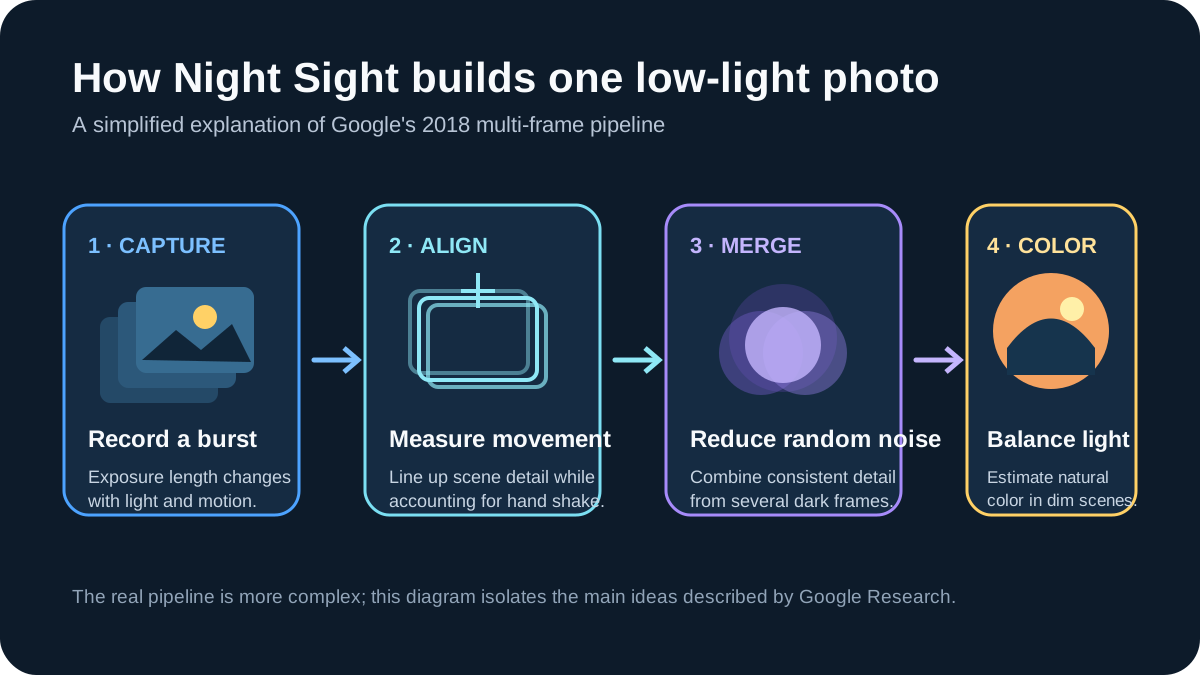
Merging is valuable because random noise does not appear identically in every frame, while real scene detail is more consistent. Alignment is essential: without it, combining frames would produce doubled edges and blur. The system’s motion measurement therefore influenced both how the burst was captured and how its contents could be assembled.
This was not the same as inventing a daylight scene. The camera still needed light, and Google explicitly described limits such as focus failure at very low illumination. Night Sight was a method for extracting a more readable result from the light and motion the phone could actually observe.
What role did machine learning really play?
Machine learning was one part of a larger imaging pipeline, not a magic switch. Google used a learning-based approach to estimate white balance in difficult light. Human vision adapts to different illumination, but cameras can produce a strong orange, green or blue cast when the available light is unusual. The model helped Night Sight choose colors intended to look more natural.
Other parts of the process were grounded in conventional photography and image processing: measuring movement, selecting exposure times, aligning a burst and reducing noise through merging. Calling the whole feature “AI” can hide that engineering. Its historical value is clearer when the pieces are separated. Machine learning addressed a problem for which fixed rules often struggle, while the capture system still respected physical constraints.
The approach also varied by hardware. Google’s technical explanation noted that the original Pixel lacked optical image stabilization and therefore used shorter exposures. The Pixel 3 received a white-balancing model trained for its camera. A shared feature did not mean every generation performed identical work; software adapted to the available sensor and stabilization system.
Why was Pixel 3 central if older Pixels also received Night Sight?
The official Pixel 3 introduction gave Google a current phone on which new hardware, its HDR+ heritage and new computational techniques could be presented together. It launched in October 2018 with a single rear camera at a moment when multiple-camera systems were becoming a prominent way to advertise photographic versatility. Night Sight made a different argument: capture and processing could be as important as the visible number of lenses.
Bringing the mode to earlier Pixels strengthened that argument. It showed that a major camera improvement could arrive through an app update, although the experience still depended on each phone’s hardware. That distinction matters. Software can extend a camera’s useful life and unlock techniques that were not available at launch, but it cannot make sensor area, optics or stabilization irrelevant.
Pixel 3 also connected this camera story to the wider move toward adaptive software in Android 9 Pie. Both products used computation to reduce decisions a user had to make manually. Night Sight selected a capture strategy; Android Pie tried to adapt power and interface behavior to patterns of use.
How did Night Sight change the way phone cameras were judged?
In hindsight, Night Sight helped move low-light performance from a specialist test to a normal expectation. Reviewers and buyers could ask not only how large a sensor was, but how well a phone handled motion, color and noise after the shutter was pressed. Competing manufacturers already used multi-frame imaging, so it would be inaccurate to say Google invented computational photography in 2018. Pixel 3’s contribution was to package a sophisticated night pipeline as a clear, accessible mode and make its effect easy to recognize.
The shift also complicated comparisons. A camera could produce different results after an app or system update. Two phones using similar sensors could behave differently because their exposure selection, alignment and color models differed. Camera quality became a property of maintained software as well as factory hardware.
That lesson later spread well beyond night modes. Portrait blur, high dynamic range, zoom, face selection and motion correction increasingly combined many frames or learned models. Night Sight offers a particularly understandable case because the before-and-after problem—too little usable light—is so visible.
Why does this 2018 milestone still matter today?
Modern phone cameras routinely perform substantial work before displaying a finished image. Night Sight helps readers understand what that computation can and cannot do. It can select and combine evidence more intelligently, but scene movement, lens quality and sensor limits still affect the result. A dramatic night photo should therefore be evaluated for detail, motion handling and natural color, not brightness alone.
The feature also established a lasting expectation that camera capability may improve after purchase. Google’s later custom-chip direction with the Pixel 6 and Tensor pushed the same hardware, software and machine-learning relationship deeper into the phone. Follow the broader sequence in our Android history collection: Pixel 3 marks the moment when “the camera” became visibly inseparable from the computation behind it.