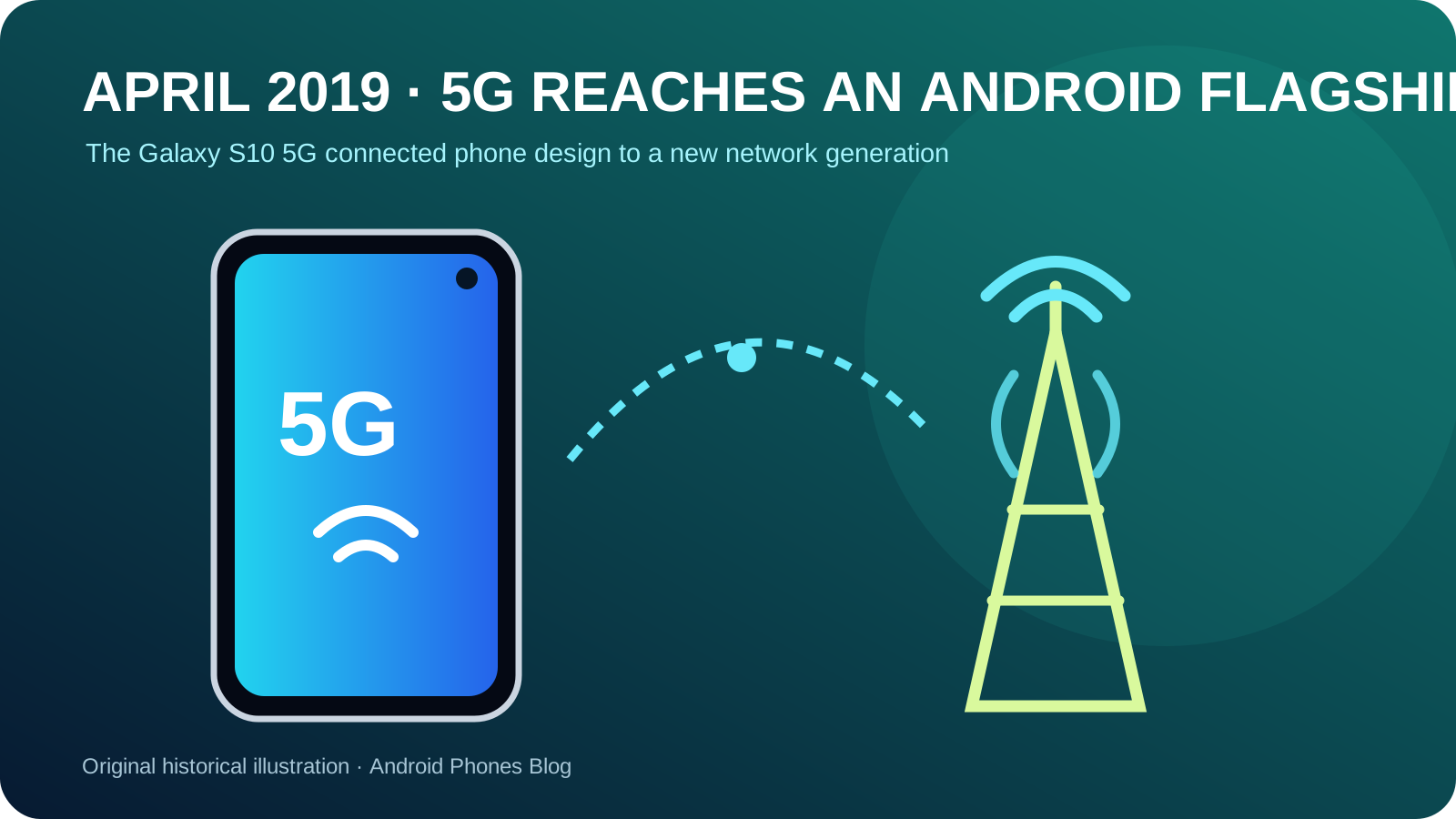
The Galaxy S10 5G went on sale in South Korea on April 5, 2019. Samsung called it the company’s first 5G smartphone on the market, and its release placed a next-generation mobile radio into a device ordinary customers could purchase where compatible service was available. The official availability announcement paired that new connection with a 6.7-inch display, a 4,500mAh battery and 25W wired charging.
Those additions show why 5G history is not only a story about a faster icon in the status bar. A new radio generation involved networks, modems, antennas, power, heat, software and coverage. The S10 5G made that complete system visible at the start of commercial deployment.
What did “5G phone” mean in early 2019?
A 5G phone included radio hardware and software capable of connecting to a compatible fifth-generation mobile network. That did not mean it would use 5G everywhere. Operators had to deploy service in specific locations and bands, and the phone still relied on 4G where 5G was unavailable or for parts of the connection architecture.
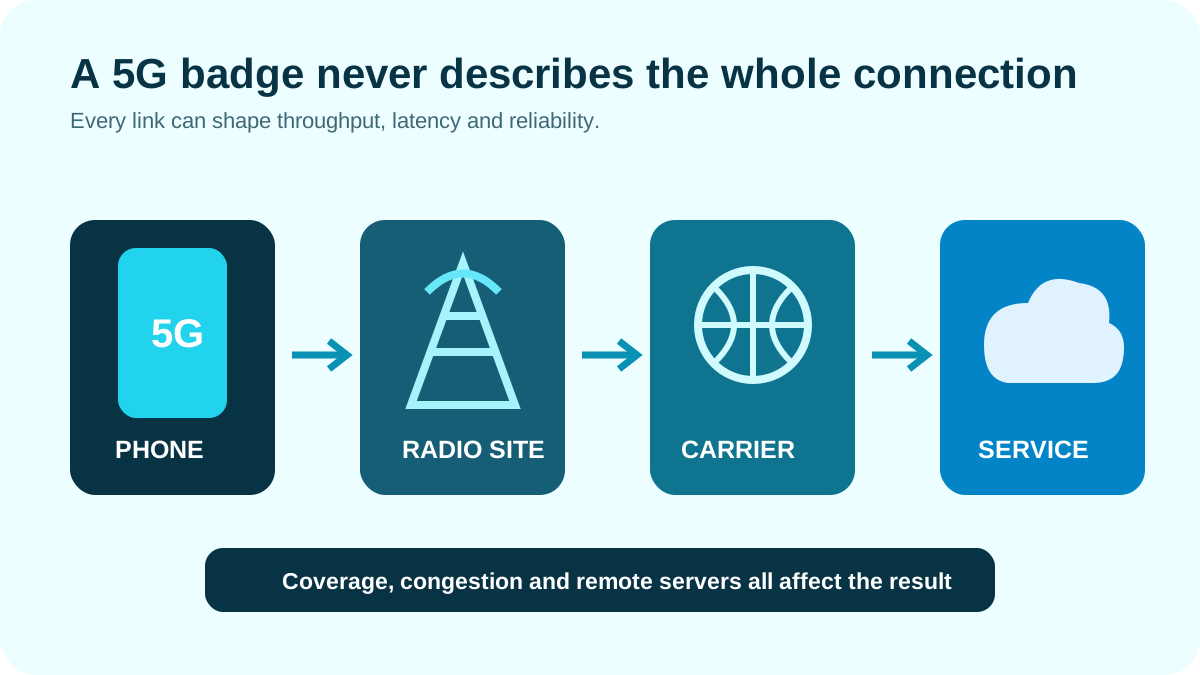
Samsung’s Korean launch material described commercial network work involving operators as well as the company’s network core and radio equipment. The phone was one endpoint in that chain. A server, carrier backhaul, local radio site, spectrum conditions and handset all affected what a user experienced.
The historical “first” label also needs scope. Samsung described the S10 5G as the world’s first 5G smartphone in its own materials, but other devices and modular approaches were part of the broader transition. The durable fact is that the S10 5G was an early integrated handset released into a live commercial market on a documented date.
Why did the 5G model need different hardware?
The S10 5G was not simply a standard S10 with a menu option enabled. The S10, S10+ and S10e had already gone on sale in March. The 5G model used a larger body, the largest display in that generation’s S10 family, a larger battery and a different charging specification. Samsung also gave it 256GB of base storage and a 3D Depth Camera intended for depth measurement and augmented reality uses.
| Part of the system | 2019 requirement | Why it affected the phone |
|---|---|---|
| 5G radio and antennas | Support deployed bands and network mode | Added components and validation work |
| Battery and charging | Sustain demanding radio and media use | Influenced capacity, size and charging design |
| Thermal management | Control heat during high data activity | Could affect sustained performance |
| Android and apps | Recognize network capabilities | Allowed software to adapt behavior |
These relationships matter more than an isolated peak-speed number. Early radio hardware was less integrated than later generations, and a larger device gave engineers more room for components, battery capacity and heat management. Later 5G phones would make the feature common across smaller and less expensive models as chipsets and networks evolved.
What experiences did Samsung expect 5G to enable?
Samsung emphasized quick large downloads, high-resolution streaming, cloud gaming, video communication, augmented reality and virtual reality. Its technical interview about the S10 5G connected higher throughput and lower latency to cloud-rendered games and real-time media.
Those were intended use cases, not evidence that every service was mature in April 2019. A cloud game needed suitable servers and software; a high-resolution stream needed content and a plan that permitted the data use; an AR experience needed more than a fast link. New network capacity created possibilities, but developers and providers still had to build valuable services around it.
This separation prevents hindsight from turning launch expectations into confirmed outcomes. The S10 5G demonstrated access to a new network. It did not by itself prove which applications would become the defining reason to use it.
Why could early 5G feel inconsistent?
Coverage was initially concentrated rather than universal. A user could move between 5G and 4G within one journey, and indoor reception could differ from an outdoor coverage map. Different markets used different spectrum, deployment timelines and device variants. Even when a 5G indicator appeared, the remote service might be the bottleneck.
Peak laboratory or marketing rates therefore could not predict one person’s everyday result. Throughput describes how much data can move over time; latency describes delay; reliability describes whether performance remains available. A faster download does not automatically produce lower application latency, and a low-latency radio cannot remove delay from a distant server.
The correct historical reading is not that early 5G “didn’t work” or that it instantly transformed every task. It was a staged network transition. The S10 5G gave early users access where the system was deployed and gave manufacturers real experience integrating the technology.
How did Android have to adapt to 5G?
Applications need a meaningful description of connectivity rather than a brand label. They may choose higher-quality media on an unmetered, capable network or reduce transfers when a connection is constrained. They also need to handle changes without losing state when a phone moves between network types.
The Android 10 developer overview listed 5G among the platform areas receiving support. Later Android APIs would add more explicit ways to identify 5G capabilities and metering conditions. The direction began with treating a new radio as information the operating system could expose safely to software.
This was a shared-platform advantage. Samsung built the device and participated in network deployment, while Android supplied common behavior for applications across manufacturers. No single layer could deliver the whole 5G experience.
Was the S10 5G mainly about speed or about an ecosystem transition?
Speed made the idea easy to advertise, but the ecosystem transition was more consequential. Carriers had to install equipment and sell compatible service. Chip suppliers had to integrate modems efficiently. Phone designers had to place antennas for multiple bands. Regulators allocated spectrum. App and cloud providers decided whether new capacity justified different experiences.
The S10 5G sat where those projects met. Its larger dimensions and early-market availability captured the cost of starting the transition; later products captured the benefits of integration and scale. By the end of 2019 Samsung had expanded its 5G range beyond one S-series model, but the April launch remains a clear starting point for its consumer handset story.
That pattern resembles the Galaxy Fold from the same year. Both introduced a visible hardware capability while depending on platform and application support. Neither can be understood from one specification alone.
The launch does not show that every country received the same model on April 5; the first market was South Korea, with other releases later. It does not show that every 5G network used the same bands or architecture. It does not establish that advertised maximum rates were normal user speeds. It also does not mean a 4G phone became useless when 5G service began.
These distinctions are not minor caveats. Network generations coexist for years, and compatibility is regional. A phone’s supported bands, carrier certification and local deployment determine whether its 5G hardware is useful. The same checks remain necessary when a used or imported phone moves to a different market.
Why does the Galaxy S10 5G still matter today?
The S10 5G records the moment when 5G moved from standards and demonstrations into an integrated Android phone sold on a live commercial network. It shows the extra hardware and system coordination required before the feature became a routine line on midrange and premium specification sheets.
For modern readers, its lesson is practical: a network badge never describes the complete experience. Check supported bands, local coverage, battery and thermal behavior, plan terms and software support. Our Android history collection follows how such once-new capabilities became ordinary. The S10 5G matters because it exposes the entire chain—from phone to radio site to carrier to service—that still determines what mobile connectivity can actually do.