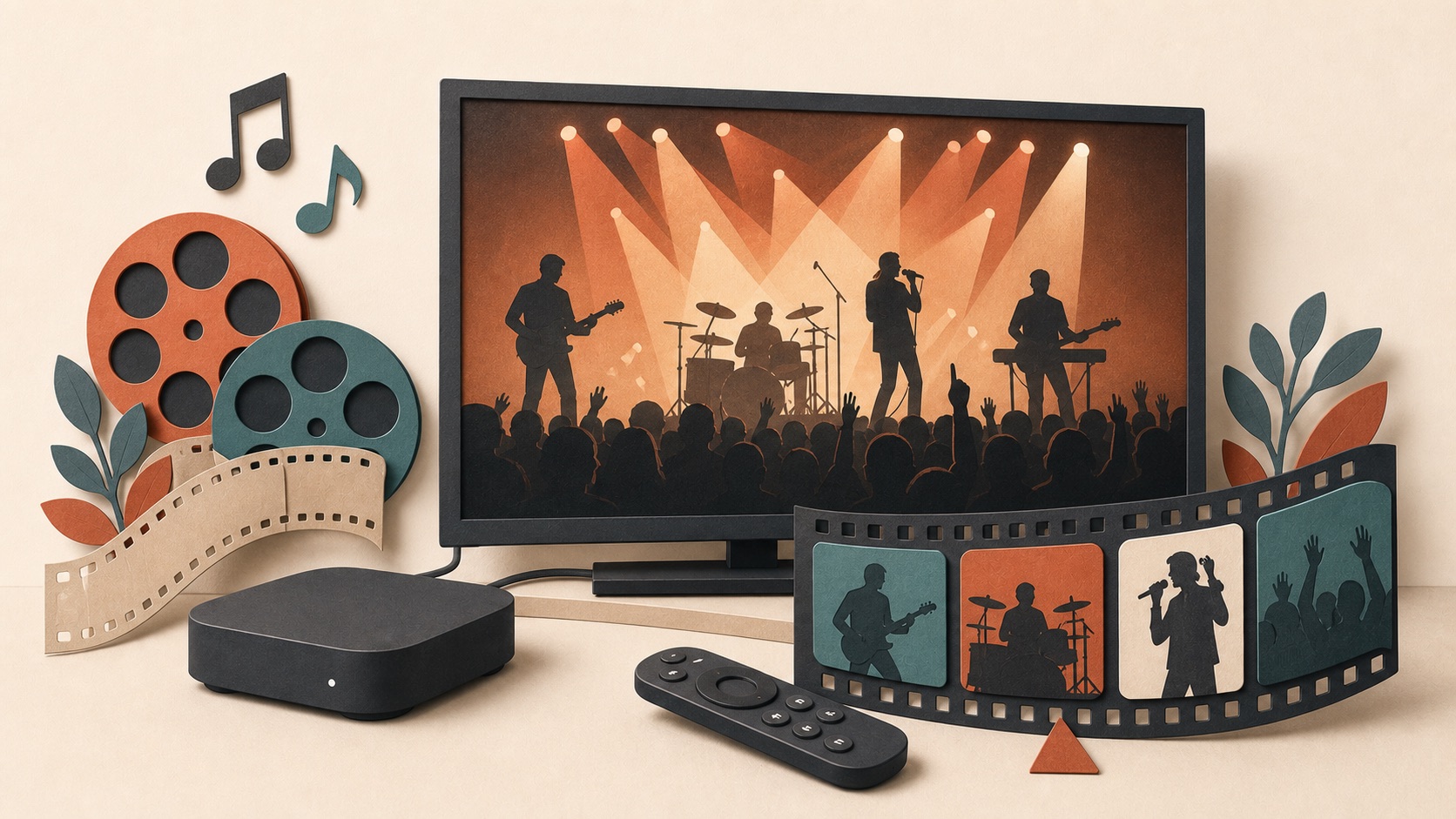
Archive update: Qello released a Google TV application through Android Market in late December 2011. The service focused on HD concert films and music documentaries, giving early Google TV owners a specialized streaming catalog rather than another general movie-and-television app.
What did Qello offer on Google TV?
Qello promoted a library of live performances that viewers could stream on a television. Contemporary coverage also highlighted custom setlists, allowing a viewer to combine performances from different artists instead of choosing only a single full concert.
The original Google TV download was reported at approximately 5.4 MB. The small application acted as a catalog and streaming client; the video library itself was delivered over the internet rather than stored inside the app.
What did a small application download actually contain?
The reported 5.4 MB size did not represent the concert library. The local app provided the interface, account and playback logic needed to browse a remote catalog and request a stream. Artwork, metadata and video could be delivered as the viewer navigated and watched. That separation kept the installation small while allowing the service to update its library without shipping a new package for every title.
It also made the experience dependent on the network and service. A full concert requires sustained delivery for much longer than a short clip, so connection quality affects buffering and picture resolution. The catalog endpoint must remain available, and rights rules may determine whether a selected performance can play in the viewer’s location.
| Product layer | Qello’s Google TV role |
|---|---|
| Catalog | Organize full concerts and music documentaries by artist and genre |
| Playback | Stream long-form video to the largest screen in the home |
| Personalization | Let viewers assemble custom setlists from separate performances |
| Distribution | Use Android Market to reach installed Google TV devices |
Why were custom setlists a meaningful feature?
A full concert preserves the order and pacing of one event. A custom setlist turns the catalog into something closer to a personal music channel. A viewer could select favorite performances from different artists and create a sequence that did not exist as one filmed show.
That feature used the advantages of a software catalog rather than merely copying a disc menu. Individual songs needed useful metadata and reliable start points, and the interface had to make adding, ordering and playing selections comfortable from across a room. The service could then support both modes: watch a complete performance as produced or assemble a personalized session.
Setlists also increased the value of catalog depth. A viewer interested in one song might discover another artist through a mixed sequence. For Qello, this created more paths into long-form content than asking every visitor to choose a two-hour concert at the start. Personalization helped a specialist library feel flexible rather than narrow.
Why was a concert-focused app distinctive?
Streaming platforms often compete on broad catalogs. Qello used a narrower position: professionally filmed concerts and music documentaries for fans who wanted a living-room experience.
That focus offered three advantages:
- The content category was easy to explain.
- Television screens and speakers suited long-form performances.
- Artist and genre metadata supported browsing and personalized setlists.
It also created challenges. Music rights can vary by country and can expire, so the available catalog and supported territories are not necessarily permanent.
What are the strengths and limits of a niche catalog?
A focused service can explain itself clearly. Qello was not asking viewers to search a general video library and hope that concert films were included. The category, viewing occasion and audience were visible from the product concept. That clarity can improve marketing and make editorial curation more coherent.
Specialization also concentrates risk. The addressable audience is smaller, and the service must acquire enough desirable performances to make a subscription or repeated visit worthwhile. Fans may judge the catalog by the absence of a particular artist, genre or era. Rights negotiations can fragment availability by territory and remove a title after it has been featured.
What did the launch show about Google TV?
Google TV’s app model allowed services built around phones and web streaming to design a large-screen interface. This was an early example of Android extending beyond handsets into shared home-entertainment devices.
The platform still faced adoption and interface problems, but specialized apps like Qello demonstrated the underlying opportunity: a television could become a software platform where niche media services reached viewers directly.
What did Qello need to change for a television interface?
A TV application must remain readable from several feet away and usable with a directional or keyboard remote. Rows, focus states and selection feedback matter more than fine pointer precision. Artwork has to explain content quickly, while long descriptions and small controls can make navigation feel like a website shrunk onto the screen.
Playback also belongs to a shared environment. The app should make it obvious which concert or setlist will begin, preserve progress when appropriate and allow basic controls without returning to a dense menu. Search may be useful, but browsing by artist or genre reduces the amount of typing required on a living-room controller.
These requirements explain why app availability alone was not enough for Google TV. Services needed to rethink navigation for distance, shared viewing and long sessions. Qello’s content was well suited to a large screen and speakers, but the interface still determined whether viewers could reach that content without friction.
The app arrived while Google TV hardware strategies were diverging. Logitech was clearing the last Revue set-top boxes, whereas LG was preparing an integrated Google TV and Cinema 3D television. Google was also exploring phone-assisted voice controls. Qello supplies the content side of that picture: hardware and controls only became useful when people had something distinctive to watch.
How did content help define the platform?
Hardware demonstrations can show search, multitasking and web access, but viewers buy a television product to watch something. A concert service supplied a concrete answer: select a performance, use the home sound system and spend a full session with content that benefits from a large display.
Specialist apps also broadened the meaning of a television channel. Qello did not need a fixed broadcast schedule or space in a cable package. Android Market gave it a software distribution path, while streaming delivered the catalog on demand. That model allowed a focused media company to appear beside larger services in the same device interface.
The opportunity depended on installed hardware. A strong app could make Google TV more useful, while a small Google TV audience limited the number of potential subscribers for the app. Platforms and content providers therefore created value for one another, but each also carried the other’s adoption risk.
Is the original Google TV app still the current product?
No. The original Google TV platform was replaced, and Qello later became Qello Concerts by Stingray. Current device support, subscription terms and catalog availability should be checked on Qello’s official site and present app-store listings.
The present Qello Concerts service should be evaluated on its current catalog, supported devices, price and regional terms. The archived Android Market size and Google TV availability cannot answer those questions. They document how the service entered an early connected-TV ecosystem and why concert films were a plausible fit for it.
This restored article preserves the 2011 launch without presenting old download instructions as current. Continue with the history of the Google TV collection or browse more Android and connected-device coverage.