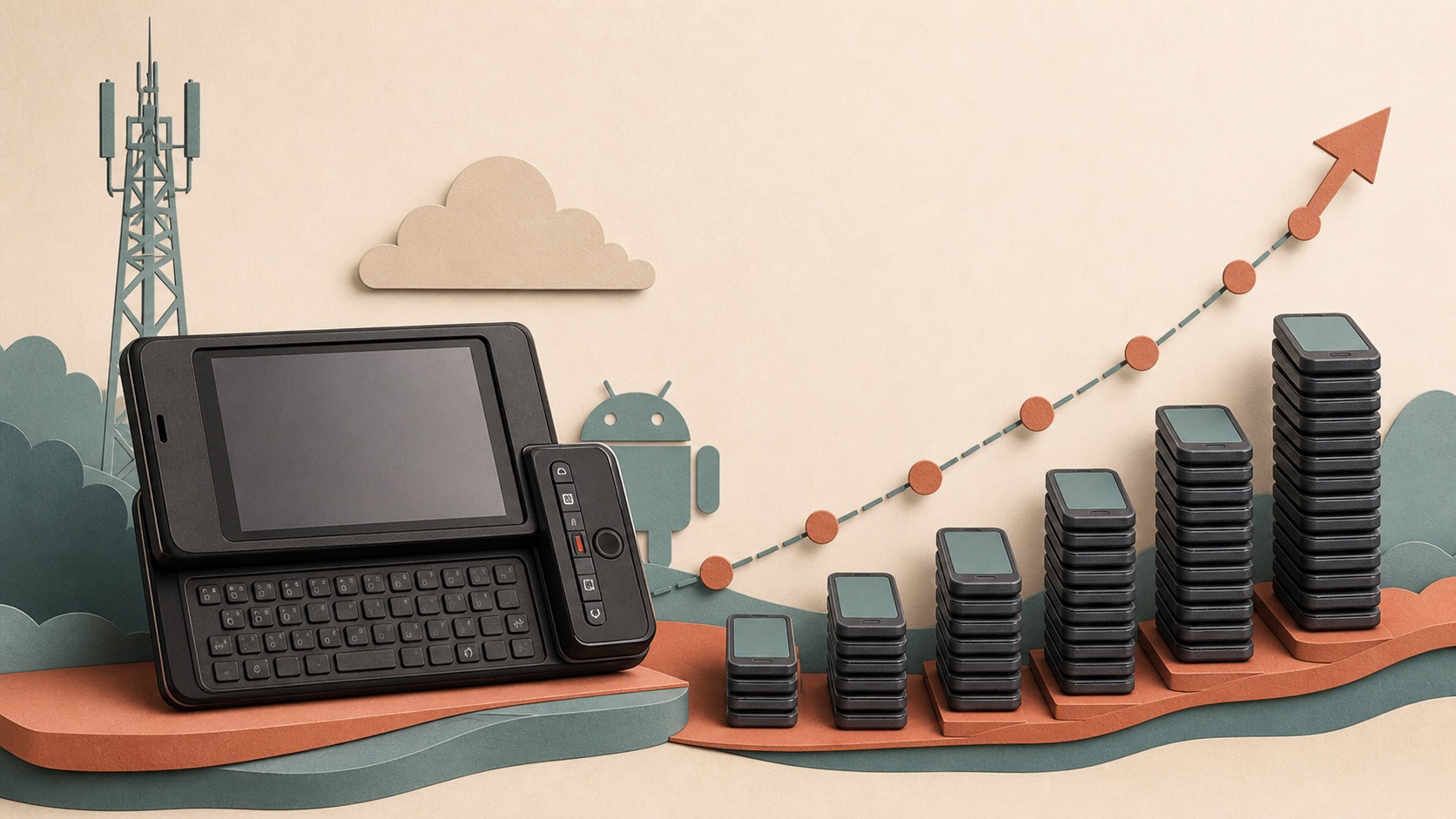
Archive update: In November 2009, an analyst forecast estimated that Motorola and Verizon could sell roughly 600,000 Droid smartphones by the end of the year. The number was a projection—not a final company-reported result—but it captured how quickly the original Droid changed expectations for Android in the United States.
What was the 600,000-unit forecast based on?
Broadpoint AmTech analyst Mark McKechnie reportedly raised his launch estimate after early demand appeared stronger than expected. The projection included approximately 200,000 additional units by Black Friday and another 150,000 to 200,000 during the remainder of the holiday period.
| Forecast component reported in November 2009 | Estimated units |
|---|---|
| Additional sales through Black Friday | About 200,000 |
| Remaining holiday-period sales | About 150,000–200,000 |
| Full fourth-quarter Droid forecast | About 600,000 |
| Droid plus Motorola CLIQ quarterly forecast | About 1 million |
The same analysis expected Motorola to sell about one million Android phones in the quarter when Droid and the Motorola CLIQ were combined. It also projected a much larger Android portfolio in 2010.
These numbers should be read carefully. Smartphone reporting often mixes units shipped to carriers with devices purchased by end users. An analyst forecast can signal market confidence, but it is not equivalent to audited sell-through.
Forecast, shipment or sale: what did the number represent?
The reported 600,000 figure was an analyst’s fourth-quarter forecast. It was not a statement from Motorola that 600,000 consumers had activated a Droid, and it was not a final count audited after the holiday season. That difference matters because several measurements can appear in launch reporting.
Shipments describe units a manufacturer sends into a carrier or retail channel. Sell-through describes units bought by end customers. Activations usually refer to devices connected to a carrier account. A forecast can estimate any of those measures, sometimes before complete channel data exists. Inventory may also remain in stores after it has been counted as shipped.
The original report is most reliable as a snapshot of rising expectations. An analyst increased the estimate after seeing early demand signals and anticipated additional holiday sales. It shows that Droid’s launch looked stronger than initial assumptions, even though the article alone cannot establish the exact number ultimately used by customers.
Why did the original Motorola Droid matter?
The Droid paired Android with Verizon’s distribution and a major advertising campaign. It gave U.S. buyers a prominent alternative to the iPhone and helped move Android from a collection of early devices toward a recognizable consumer platform.
Three elements made the launch significant:
- Verizon placed Android in front of a large national subscriber base.
- Motorola treated Android as the foundation of a broader smartphone recovery.
- The campaign gave the operating system a product identity mainstream buyers could remember.
Why did Verizon’s channel matter so much?
In 2009, a smartphone launch depended heavily on carrier retail distribution. A device needed trained store staff, visible displays, rate-plan support, inventory across many locations and marketing that explained why a customer should switch. Verizon supplied that machinery at national scale. Android was no longer represented only by early-adopter interest in a new operating system; it appeared as a named product backed by a major network.
That channel also changed the audience. A buyer walking into a carrier store could compare Droid with other subsidized phones, ask about coverage and leave with service activated. The product did not have to win attention solely through technology coverage. This is one reason an apparently modest unit forecast is historically meaningful: it indicated that Android could perform inside a mainstream U.S. sales system.
Motorola benefited from the same arrangement. The company needed a compelling smartphone line, while Verizon wanted a strong response to devices available on competing carriers. Android gave both companies a shared software foundation, but distribution and promotion turned that foundation into a consumer launch.
The launch also marked a change from Android’s first-year experimentation. D2 Technologies had used the HTC G1 for a VoIP and unified-communications demo months earlier, showing technical flexibility. Droid added national carrier distribution and consumer marketing. Google’s Nexus One and Android 2.1 release then supplied a reference-device model for the platform’s next phase.
How did the holiday timing shape the forecast?
Droid went on sale close to the most important U.S. retail period of the year. That compressed the time available to reach the forecast but also concentrated buyer attention, advertising and gift purchases. Black Friday served as an early checkpoint: strong promotional performance could force analysts to revise estimates while there was still a month of holiday demand ahead.
Short launch windows can make projections volatile. Initial stock shortages may look like exceptional demand even when supply is simply limited. Promotions can pull purchases forward from later weeks. Returns, replacements and channel inventory may not be visible in the first reports. For those reasons, the table above is best read as the structure of the analyst’s scenario, not four separate confirmed sales results.
The value of reconstructing that scenario is that it exposes the assumptions: continued momentum after launch, a Black Friday boost and another meaningful wave before year-end. Readers can judge the forecast more intelligently when the components are visible instead of treating 600,000 as an isolated fact.
What did Droid change for the wider Android ecosystem?
A larger installed base gives application developers more potential users and gives accessory makers more reason to support a device. It also makes carriers and competing manufacturers take the platform more seriously. One successful model does not guarantee ecosystem dominance, but it can reduce uncertainty for every company deciding whether to invest in the next product cycle.
Droid helped demonstrate that Android could support a recognizable flagship, not only a range of loosely connected experiments. At the same time, its carrier-specific launch showed that Android’s growth would be distributed among manufacturers and network partners. That combination—shared software with different hardware, brands and sales channels—became one of the platform’s defining strengths and one of its sources of complexity.
What can today’s buyers learn from this launch?
Historical sales forecasts are most useful when they reveal market structure. The Droid showed that software alone does not create demand: carrier reach, retail availability, hardware differentiation and promotion all shape a phone’s commercial performance.
For wholesale buyers, the modern equivalent is to evaluate the complete channel fit rather than a specification sheet in isolation. Network bands, local service support, software update expectations and replacement stock can matter as much as processor or camera specifications. See our practical guide to wholesaling mobile phones from China for a current sourcing framework, or follow the early Android timeline for more historical context.