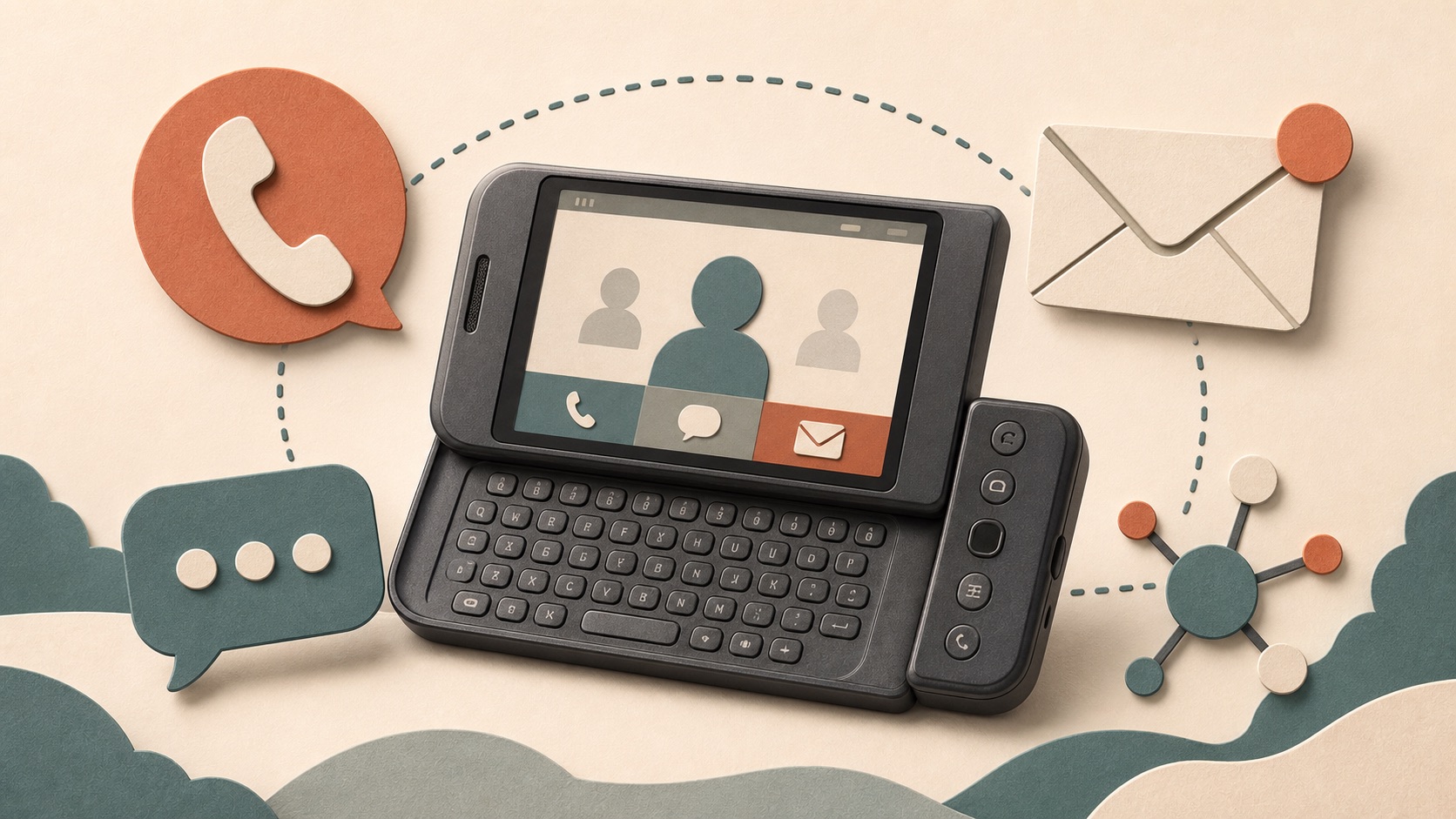
Archive update: D2 Technologies used the HTC G1 to demonstrate how Android could support a converged communications interface combining cellular voice, VoIP, instant messaging, SMS and email. The Mobile World Congress 2009 demo was aimed at manufacturers and service providers evaluating Android for more than consumer applications.
What was D2’s mCUE demonstration?
mCUE was presented as a communications client and software framework for multi-mode mobile devices. On the HTC G1, it placed several kinds of sessions in one presence-aware interface instead of treating calls and messages as unrelated services.
The platform paired D2’s user interface with its vPort MP VoIP software. D2 said the combination could connect with enterprise IP PBX and unified communications systems as well as internet messaging services available at the time.
What did “unified communications” mean in 2009?
The phrase described an effort to make several business communication systems behave like one service. A typical employee might have had a desk-phone extension, a mobile number, voicemail, corporate instant messaging and email, with a different interface and contact list for each. Moving away from the desk often meant losing access to PBX functions or asking callers to try another number.
mCUE proposed a mobile layer over that fragmented setup. Presence information could show whether a colleague was available, while a shared contact view could start a cellular call, a VoIP session or a message. The value was not simply putting more icons on a phone. It was reducing the number of decisions a user had to make before reaching someone and allowing an organization to extend its existing communications system to a mobile device.
That distinction explains why the demonstration was aimed at manufacturers and service providers. D2 was presenting technology that could be embedded, customized and connected to other infrastructure, not a finished social app that every G1 owner could download and use without configuration.
| Communication type | Intended role in mCUE |
|---|---|
| Cellular voice | Conventional mobile calling |
| VoIP | Calls carried over IP networks |
| Instant messaging | Presence-aware real-time messaging |
| SMS and email | Common asynchronous messages in the same workflow |
| PBX features | Enterprise calling functions on a mobile device |
How might a presence-aware mobile client change a call?
Consider an employee who needs to reach a colleague while away from the office. Without integration, the employee might call a desk number, wait for voicemail, try a mobile number and then send an instant message. A presence-aware client could instead show that the colleague was online but already on a call, making a message the more sensible first action. If the colleague became available, the same contact card could begin a voice session over the appropriate network.
The proposed interface therefore sat above the individual transport. Cellular voice and IP voice were still technically different, with different coverage, quality and cost characteristics, but the user did not need to begin every task by choosing a protocol. The software could present the person and available actions first.
This was ambitious on a 2009 smartphone. Reliable handoffs, battery use, background connectivity and enterprise security all affected whether the experience could work outside a controlled demonstration. The demo proved that Android could host the interface and communications stack; it did not prove that every carrier network or PBX deployment would behave identically.
Why use the HTC G1?
The G1 was the first commercial Android smartphone, making it a practical proof point for companies deciding whether Google’s new operating system could support specialized communications products. A working demonstration on shipping hardware was more persuasive than a desktop prototype or a theoretical roadmap.
The announcement also illustrated Android’s early appeal to equipment makers. Its open software stack allowed vendors to build differentiated interfaces and integrate communications services without creating an entire mobile operating system from scratch.
What would a real deployment have required?
A manufacturer or operator evaluating mCUE would have needed to look beyond the handset demonstration. Enterprise calling features depend on compatibility with the organization’s PBX or unified-communications server. VoIP quality depends on network latency, packet loss and how the phone handles movement between Wi-Fi and mobile coverage. Contact presence also needs reliable account identity and server connections.
Security was equally important. A mobile client touching corporate calls and messages needed authenticated access, protected signaling and a plan for lost devices. Administrators would want provisioning, policy controls and a way to remove access when an employee left the company. Device makers had to consider how their software changes would be maintained as Android itself evolved.
Those requirements do not weaken the significance of the G1 demo. They clarify what it established: Android was flexible enough for specialized communications software, and a working commercial phone could serve as the starting point. Productization still depended on integration, testing, support and agreements among software vendors, hardware makers, carriers and enterprise customers.
Where did the demo sit in Android’s early timeline?
The April 2009 demonstration arrived before Verizon’s high-profile Motorola Droid launch and 600,000-unit forecast. That timing matters: companies were already testing Android for enterprise communications while the operating system was still building mainstream name recognition in the United States.
By January 2010, the Nexus One and Android 2.1 SDK gave developers a newer reference device and a clearer compatibility target. Read together, the stories show Android moving from an adaptable G1 software platform to a coordinated hardware-and-SDK ecosystem in less than a year.
What should not be inferred from the demonstration?
The archive does not show that mCUE replaced the G1’s standard dialer for the general public, that all of its proposed integrations shipped in one retail product or that VoIP quality matched a conventional call in every situation. It records a vendor demonstration and the market direction it represented.
That evidence is still useful. Many ideas shown in early prototypes later became ordinary expectations: one contact can be reached through several apps, business calls can follow an employee away from a desk, and a phone can move between carrier and internet-based communication. The exact products changed, but the user problem described in 2009 remained recognizable.
What is the historical significance?
Modern Android phones routinely combine carrier calling, Wi-Fi calling, video meetings and messaging apps. In 2009, that convergence was not yet a standard smartphone assumption. D2’s demo is useful evidence of how quickly developers recognized Android as a platform for enterprise and carrier communications.
This page records the historical demonstration; it does not claim that the original G1 software remains supported. Buyers evaluating current Android devices should focus on present carrier certification, supported voice codecs, security updates and regional network bands. Browse our other early Android stories or use our Android product and sourcing guides for current advice.